

No. Once a trucking company knows — or reasonably should know — that litigation is likely, it has a legal duty to preserve all relevant evidence. That includes black box data, driver logs, maintenance records, and any other documentation connected to the crash. Destroying that evidence after that duty arises is called spoliation, and Georgia courts take it seriously. Companies know not to destroy the truck, move it, allow it to be destroyed, or modify it in any way. Georgia law states that failure to preserve important evidence like this can lead to severe adverse legal consequences. AMLI Residential Props., Inc. v. Georgia Power Co., 293 Ga. App. 358, 363 (2008).
What Evidence Exists After a Commercial Truck Accident
Commercial trucks generate far more evidence than a typical passenger vehicle crash. That evidence can be decisive in proving liability — and trucking companies know it.
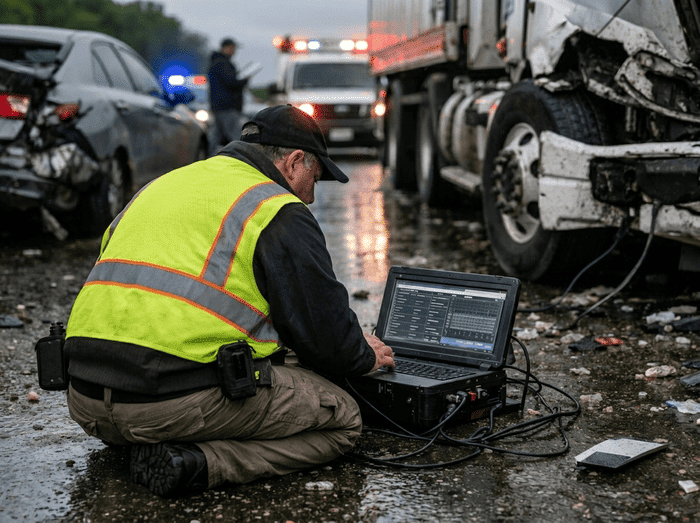
The most critical piece is the Electronic Control Module, commonly called the black box or ECM. It records:
- Vehicle speed in the seconds before impact
- Brake application and timing
- Engine throttle position
- Cruise control status
- Seat belt use by the driver
Beyond the black box, other evidence includes Hours of Service logs under federal FMCSA regulations, the driver’s qualification file, drug and alcohol testing records, GPS and geofencing data, inward and outward-facing dash cam footage, and the trucking company’s post-accident internal reports.
This evidence does not last forever. Black box data can be overwritten within 30 days — sometimes sooner — depending on the truck’s model and the distance driven after the crash.
What Is a Litigation Hold and When Does It Apply
A litigation hold is a legal obligation to stop the routine destruction or overwriting of documents and data once litigation is reasonably anticipated. In a commercial truck accident, that duty typically arises at the moment of the crash itself.
Trucking companies are sophisticated defendants. They employ safety directors and often have legal counsel on retainer. They understand their obligations. When a company ignores those obligations — or actively destroys evidence — that is not an accident.
Under Georgia law, a party that destroys relevant evidence after a duty to preserve has arisen can face serious consequences in court.
What Happens When Evidence Is Destroyed
Georgia courts can impose sanctions for spoliation of evidence. The consequences depend on the circumstances, but they can include:
- An adverse inference instruction — the jury is told it may assume the destroyed evidence was harmful to the trucking company
- Exclusion of the company’s expert witnesses or defenses
- Dismissal of the company’s counterclaims
- In egregious cases, default judgment in favor of the injured party
An adverse inference instruction is particularly powerful at trial. It tells jurors that the company had evidence, chose to destroy it, and that they are permitted to conclude the evidence would have hurt the company’s case. That instruction can shift the outcome of a trial.
How to Trigger the Duty to Preserve Immediately
The single most effective step an injured party can take is sending a spoliation letter — also called a litigation hold letter — to the trucking company and its insurer as quickly as possible after the crash.
This letter formally notifies the company that litigation is anticipated and demands preservation of all relevant evidence. Once received, the company cannot claim it was unaware of its preservation duties.
I send spoliation letters immediately in every truck accident case I handle. The goal is to create a clear record that the duty to preserve was established on a specific date. If evidence disappears after that date, the company has no credible defense.
What to Do If You Suspect Evidence Has Already Been Destroyed
If you believe a trucking company has already deleted or overwritten critical data, that fact itself becomes part of your case. Your attorney can pursue discovery specifically focused on the company’s data retention policies, who had access to the ECM, and when the data was last downloaded or purged.
Forensic data experts can sometimes recover overwritten ECM data. Trucking company employees who participated in evidence destruction can be deposed. Internal communications about the crash — including emails sent in the hours after the collision — are discoverable.
Evidence destruction does not end a case. In some situations, it strengthens it.
Why Acting Quickly Is the Most Important Step You Can Take
The window to preserve black box data and other critical evidence is measured in days — not weeks. Trucking companies dispatch their own investigators to crash scenes immediately. By the time most accident victims have left the hospital, the other side has already begun building its defense.
If you or someone you know was injured in a commercial truck accident in Atlanta or anywhere in Georgia, the time to act is now. An experienced Atlanta truck accident lawyer can issue a spoliation letter, retain accident reconstruction experts, and move to preserve evidence before it disappears.
Talk to Tobin Injury Law Before Evidence Disappears
I offer free consultations and handle truck accident cases on a contingency fee basis — you pay nothing unless we recover compensation for you. Contact Tobin Injury Law today to protect your right to the evidence you deserve.

The information provided in this blog is for general informational purposes only and reflects the opinions of the author. It is not legal advice and does not create an attorney-client relationship. Every case is different, and results depend on the specific facts and applicable law. You should not act or rely on any information in this blog without first seeking advice from a qualified attorney regarding your individual situation.